Saturday, November 25, 2006

My Wife is a Gangster 3 Tops Pre-Sales to Asia


Click image to enlarge.

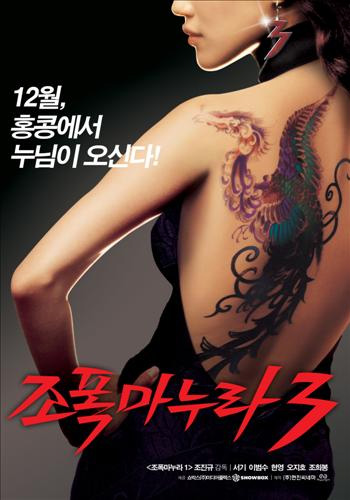
The American Film Market (AFM) saw a number of Korean films sold to various markets, with pre-sales on Korean sequel My Wife is a Gangster 3, closing successive deals throughout Asia. Korean distribution arm Showbox claims deals to Asian markets for the film reached a record high for any Korean film sold at AFM to Asian countries, not including Japan.

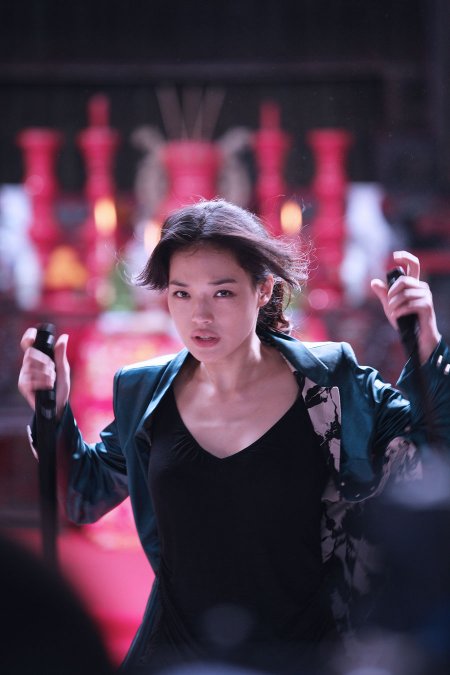
The original My Wife is a Gangster was a domestic box-office sensation in 2001, selling over 5 million tickets nationwide. The third outing for the franchise has already created a buzz, as it stars Taiwanese beauty Shu Qi as the gangster wife. She is known in the west for her award-winning roles in Hou Hsaio Hsien's films Three Times and Millenium (sic) Mambo and for her role in The Transporter.

The current sequel is directed by JO Jin-kyu who also directed the original, and is produced again by Hyunjin Cinema. Showbox said total pre-sales to Asia was at $660,000 so far, with the film sold to Sahamongkol International for Thailand, Panorama Distributions for Hong Kong, Scholar Multi-media for Taiwan, Dynamic Film International for China, Cathay Keris Films for Singapore and Malaysia, PT Amero Mitra Film for Indonesia, and BHD for Vietnam.

Korean sequels do tremendously well at home, often simply by virtue of being a sequel. Other hit sequels include Marrying the Mafia 2 and 3, Another Public Enemy and My Boss, My Teacher. In production are the sequels Mapado 2 and My Tutor Friend 2, while plans to produce sequels to The Host and Tazza: The High Rollers are already being discussed.

Nigel D'Sa (KOFIC)
Link to original article.

Friday, November 17, 2006

China Draws up Drama-Based 'Weird Korean Customs' List


Click image to enlarge.
Chinese fans of Korean soap operas were baffled to see Koreans use both spoons and chopsticks to eat, but not as surprised as when they saw women pull each other's hair during fights and managers strike their subordinates on the back of the head. Other notable features of Korean society for the Chinese couch potatoes are the vast difference in treatment meted out to rich and poor here and the number of marriages of convenience. In all, the China Finance Information Network drew up 80 strange Korean customs as gleaned from TV dramas. Here are 12 of them:

1. When Koreans lift their glass to drink any alcoholic beverage with someone senior, they always turn to one side.

2. If a Korean's glass is empty they pass the bottle to the person sitting with them. (In Korean culture it is frowned upon to pour yourself a glass; the proper etiquette is pouring for each other.)

3. Koreans are already putting the next bite of food in their mouths before they finished chewing the last bit.

4. Koreans use chopsticks for the side dishes but spoons for rice and soup.

5. If a Koreans suffer indigestion after meals, they treat it by pricking their fingers with needles. (This is an old folk remedy.)

6. Elderly Koreans often say, "Now that I've reached old age, I see every eyesore." (read: "My goodness, times have changed," "Where's the world heading?" etc.)

7. Korean women often resort to hair-pulling when fighting.

8. When someone hits a subordinate, it is always on the head, and most often across the back of the head.

9. The wealthy have contempt for those without, and those on the lower rungs kiss the feet of their superiors. Korean society treats the wealthy and the poor completely differently.

10. If you go into a house you must take off your shoes.

11. After sleeping, the blankets and pillows go in the closet. If Koreans go into a room, they always shut the windows and doors.

12. Many marriages are arranged for expediency or convenience.


Link to original article found at KPopVideo.

Oh Ji Ho - Gangster 3 sells like hotcakes at AFM

“My Wife is a Gangster 3” Sold at AFM
11/15/2006


The Korean comic action film “My Wife is a Gangster 3” has garnered much attention from Asian buyers at the recently-held American Film Market. Showbox, the film’s distributor, said Tuesday that the film had been sold for a total of 660,000 dollars (620 million won) to eight Asian nations -- Hong Kong, China, Thailand, Taiwan, Singapore, Malaysia, Indonesia, and Vietnam. “The price is the highest ever paid for a Korean movie at the market by Asian nations except Japan,” it added.

“In the case of Thailand, it signed a deal to invest and distribute the movie in the country instead of just importing it, which shows that the country is confident of its success,” Showbox said. “Vietnam agreed to pay a price similar to what it paid to buy “King Kong, making the movie the most expensive Korean movie it has imported.” Vietnam is reported to have high expectation for the film because it stars Shu Qi, a Hong Kong actress who enjoys great popularity in Vietnam.

“My Wife is a Gangster 3” also sold to Germany, and the distributor expects more sales after the film is completed because other countries like the U.S., Britain and France also showed great interest. “Since the remake copyright of “My Wife is a Gangster 1” was sold to Hollywood in 2001, foreign buyers have showed considerable interest in this movie series,” it said.

Starring Lee Beom-soo, Hyung Young, and Oh Ji-ho in addition to Suh Qi, the movie will be released on Dec. 28. 2006

Link to original article at KBS Global.

Wednesday, November 08, 2006

Remaking the Extraordinay

Click image to enlarge.

NO!
I don’t like re-made movies anymore than I like rebuilt electronics. Neither ever seems to make the grade.

When I read some time ago that Martin Scorsese was re-making Infernal Affairs, calling it The Departed, I just shook my head. It seems that there’s an inability on the part of American film-makers to admit there are some things other countries do well, in fact they do them better in a lot of cases.

An American mob movie can’t hold a candle to a Chinese movie about Triad activities. America lacks subtlety and class in too many ways, and no one has more class than Francis Ng as the Triad boss of Infernal Affairs ll.

Who could be more soul wrenching than the beleaguered Chan Wing Yan (Tony Leung)

or more vastly entertaining than the powerful Hon Sam (Eric Tsang)? The driven, intelligent, and in some cases empathetic SP Wong Chi Shing (Anthony Wong) is irreplaceable. Who could do it better?

Andy Lau (Inspector Lau Kin Ming)

has a dim view of The Departed. The title alone conveys nothing. A hamburger eaten and digested is departed. The title, Infernal Affairs however, speaks long and hard of degrees of Hell.

I was happy to note Andy Lau was a bright star at Pusan. He works very hard, and as a most a talented individual, he certainly deserved all the recognition given him. While there, he was asked his opinion of the remake. It wasn’t flattering.

This link will take you to a site I recently found called Asianbite.

You can read Andy Lau’s comments there.

It is hoped there will not be a remake of Infernal Affairs ll. The idea of trying to cast a replacement for Francis Ng turns my heart to ice.

Thursday, October 19, 2006

My Wife is a Gangster 3 set to open in December


Korean, Taiwanese Stars to Compete at Korean Box Office
KBS Global Entertainment News
2006-10-18

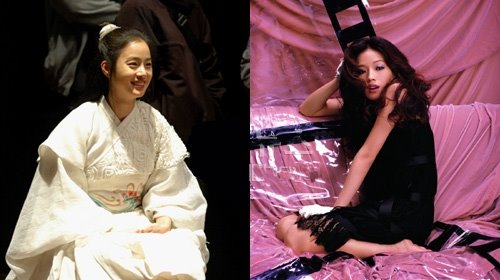
Korean top actress Kim Tae-hee will have to compete with Taiwanese top actress Suh Qi at the box office in December, when movies starring the two are released simultaneously.

The competition between “The Restless” and “My Wife is a Gangster 3” is tantamount to competition between CJ Entertainment and Showbox, the country’s two largest film distributors. Because CJ and Showbox have earned approximately the same amount of profits from the success of “The King and The Clown” and “The Host,” respectively, the success of the new films will decide the winner of the box office this year.

The competition has already started as the two revealed three-minute previews of their films as part of an event at the Pusan International Film Festival. CJ held an event entitled “Invitation to ‘The Restless’” at the Haeundae Grand Hotel in Pusan (also spelled Busan) on Saturday, while Showbox gave a presentation to introduce its lineup at a nightclub in Haeundae, Pusan on Monday.

“The Restless,” set in an imaginary place in mid-heaven where dead spirits must stay for 49 days, set itself apart with eye-catching computer graphics. Kim impressed viewers with her sharp actions in which she flourished a long sword wearing a loose outfit.

Suh Qi, wearing a traditional Chinese dress, also impressed viewers with her powerful actions in “My Wife is a Gangster 3,” which features a grander scale compared to the previous titles in the series.

Wednesday, July 12, 2006

The FTA's Effect On Korean Cinema

If you are not a fan of off-beat Korean movies such as Mi in (La Belle) or Memories of Murder for example, you might not understand why I hate the FTA, and what it does. You might be inclined to skip this article entirely.

I think you should put yourself in the shoes of the great indie producers and directors of Korea.

Did you see Fargo? If you did, be aware that it was put before you by the Cohn Brothers; a pair of mavericks who gave America one of it's best and most memorable films. The Cohn Brothers were indie producers on a shoestring budget, who gathered a cast of brilliant actors interested in the art form over the money.

Would you have wanted to miss Fargo? You might have if big studios made it impossible for such works to get a remotely fair shake. The FTA will not give the indies a fair shake. It will kill some of the most entertaining film out there.

Much of the work coming from Korea these days infinitely eclipses the average garbage America puts on the screen.

FTA Effect On Korean Cinema

"When the recent screen quota reduction cut the number of days which Korean movies could be shown in theaters from 146 to 73, critics and supporters alike turned raucous over its possible effects on the local film industry. There has been little talk, however, over its possible deleterious implications on low- to mid-budget independent art films.

For those who find themselves agreeing with Andre Bazins old Cinema du Cahiers crowd that cinema really is an art form, or those who seek a little more from movies than the passive viewing of the same overused formulas, the screen quota reduction could signal a larger problem than the United States vs. Korea cultural battle.

Korea is currently undergoing what some critics call a renaissance in cinema. During the latter half of the 1990s, Korean cinema entered a remarkable boom.

Commercial filmmakers such as Chang Yoon-hyun and Kang Je-gyu made their debuts alongside arthouse directors like Kim Ki-duk and Hong Sang-soo. Since then, Korean movies have not only done well at home, but have also garnered international attention, bringing home numerous awards from the international film circuit.

Supporters of the screen quota reduction argue that a more open market in Korea will intensify competition and raise the quality of local fims in the long run. That is assuming, however, that quality is simplistically pegged to market forces and economic success.

Hollywood will continue what it does best - mercilessly making and distributing the same tired formula. To compete with the general fare, Korea will be forced to adopt Hollywood blockbuster models - not just in movie content but in distribution and production practices as well.
(emphasis mine)

Korean blockbusters may still be able to compete with major Hollywood films in terms of market share. The real losers are likely to be independent films or low-budget films that - prior to the screen quota reduction - already existed on the margins, and screened in small arthouse theaters.
(emphasis mine)

Why take the risk of investing in movies that have an unsure future, when theaters can invest in Hollywood blockbusters that aggressive marketing alone can often ensure profit?

The reduction of the screen quota will invite every major Hollywood distributor into Korea, and if Hollywood dominates other international markets as well, such blockbuster successes are not the only things Korean filmmakers need to worry about.

Though illegal in the United States, companies often add a handful of extra movies (even third-rate ones that go straight to DVD in the United States) into a package deal when a theater signs up for a major movie. Korea should prepare for every throwaway prequel, sequel, and sequel to the sequel, etc. that Hollywood can muster.

Though Korean distribution giants may hold their own, block-booking, as the practice is known, will effectively bump smaller independent distributors out of the picture.

Take, for example, the case of international film festival regular Kim Ki-duk, who, though largely unsuccessful in Korea, has helped make a name for Korean cinema around the world, winning prizes at numerous film festivals.

A recognized auteur of cinema, the question is not whether Kim will be able to compete with an increased number of Hollywood movies in Korea; he already didnt stand a chance against the high-budget Korean films prior to the reduction.

The screen quota, Kim himself argues, is precisely what gave him and other low budget filmmakers a chance to survive.

The screen quota allowed production companies to roll out films with marginal box office power since they had to be screened for a certain period. Hollywoods permanent vacation in Korea will mean that production companies will not even begin to produce these films.

New investments henceforth will translate to higher returns for companies at the expense of low-budget films. Distributors and producers alike are set to benefit, when their combined investments are attuned to box-office appeal.

Not to say that low-budget or independent films are synonymous with the artistic; often they are just as empty of meaning as their big money counterparts. But they thrived in a system that allowed diversity, from which cinematic gems such as Kim Ki-duk emerged.

With little chance of an outlet, a whole sector of Korean film faces extinction. A high market share does not signify a healthy national cinema; Korea must maintain and further develop the independent undercurrent art scene which, though largely unseen, prevents the artistic stagnation of the national industry.
(emphasis mine)

As arthouse theaters that play primarily non-Korean films are likely to benefit from the reduction, Korean cinephiles may be reduced to watching the latest David Lynch picture, wondering what could have been."

By Chris Ro
The Korea Herald
2006.07.12